
From capital deployment to lasting impact: REAL’s perspective on the future of energy access

How do we ensure that energy access finance benefits the hardest to reach communities, and that access translates into meaningful, long-term impact? REAL Programme Catalyst took part in recent discussions at two international climate and investment forums highlighted a growing consensus around this challenge.
The global energy access sector has entered a new phase. The most accessible electrification gains have been made in urban and peri-urban areas and now those still waiting to be connected are significantly harder to reach, most costly to deploy to and geographically far more remote. This has shifted the conversation toward a more complex question: how do we ensure that finance reaches the communities that have historically been the hardest to serve, and that access translates into meaningful, long-term impact?
Recent discussions at two international climate and investment forums highlighted a growing consensus around this challenge. While the contexts were different, the reflections shared by REAL Programme Catalyst Advisory Board Member Rebecca Symington following New York Climate Week and REAL Programme Catalyst Director Ieva Indriunaite following the Nordic Climate Dialogues in Helsinki point toward a common conclusion: the sector must become more catalytic, more adaptive, and more focused on outcomes rather than outputs.
For REAL Programme Catalyst, this is precisely where Energy-as-a-Service (EaaS) and innovative financing models have the greatest potential to transform how energy access is delivered.
Learning from the past for the next phase of rural electrification
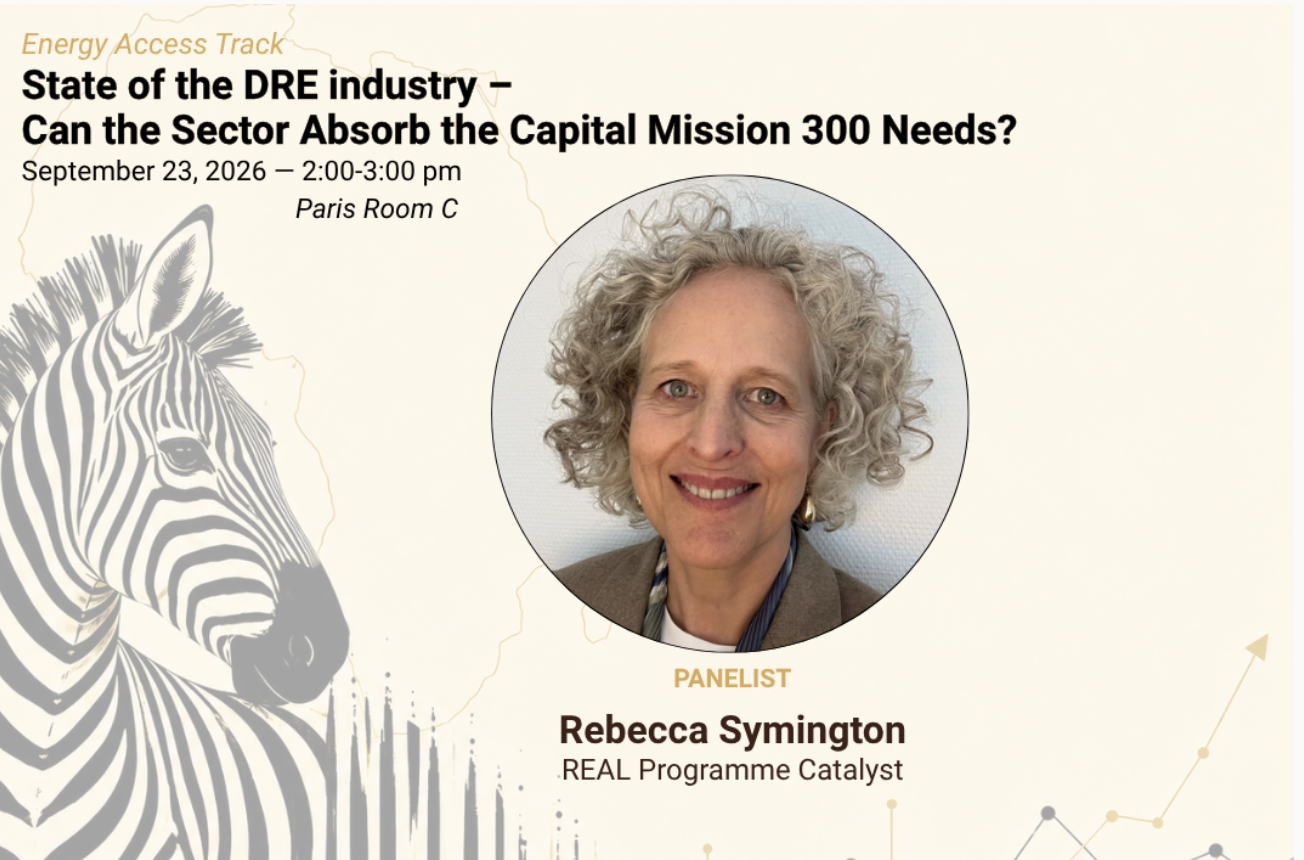
Speaking on a panel at the Africa Climate Investment Forum during New York Climate Week, Rebecca Symington reflected on how far the sector has come and the challenges that remain.
"While significant strides have been achieved in rural electrification, including companies reaching scale and profitability, large markets remain underserved," she noted. "The devil is now in the details."
The energy access sector has spent the last decade proving that distributed renewable energy can reach millions of people previously excluded from reliable electricity. However, reaching the next wave of customers, those living in more remote, lower-income, or harder-to-reach communities, requires a different approach.
Rather than repeating past models, Rebecca highlighted the need to learn from previous deployments of capital and continuously refine both business models and financing structures.
One area where this is particularly important is concessional finance.
"There is a role for concessional capital in electrifying the last mile," Rebecca observed. "But financial packages must be designed creatively to support companies that are building markets in underserved areas."
This requires recognising the realities faced by innovative businesses operating in frontier markets. Financing structures need to account for reporting burdens, pre-financing requirements, and operational constraints that can unintentionally exclude the very companies best positioned to reach underserved communities.
At the same time, concessional funding must be deployed strategically to avoid distorting markets where commercial solutions are already viable.
These considerations are becoming increasingly important as the sector evolves from supporting individual companies toward strengthening broader ecosystems.
Rebecca noted a growing shift toward interventions that fill critical market gaps, complement existing business models, and enable entire sectors to function more effectively. This ecosystem approach reflects a recognition that achieving universal energy access will require collaboration across financiers, service providers, technology companies, governments, and local communities.
Supporting data-driven decision-making to put EaaS solutions into practice
A similar theme emerged at the Nordic Climate Dialogues in Helsinki, where conversations focused on how climate finance and development institutions can remain effective in an era of constrained resources.
One remark in particular resonated with REAL Programme Catalyst Director Ieva Indriunaite:
"We have not had a failure of foresight, but of decision-making."
For Ieva, the quote captured a challenge that extends well beyond climate policy.
"The solutions already exist," she said. "The real gap lies between knowing what works and creating the institutional mechanisms to put those solutions into practice."
The discussions acknowledged a difficult reality: development and climate funding is becoming increasingly constrained, and this is unlikely to be a temporary trend.
Yet there was also a strong sense that financial pressure should not dilute ambition.
As participants emphasised throughout the event, pragmatism must not come at the expense of values. The commitment to climate action remains strong, but achieving meaningful results will require institutions to make better use of limited resources.
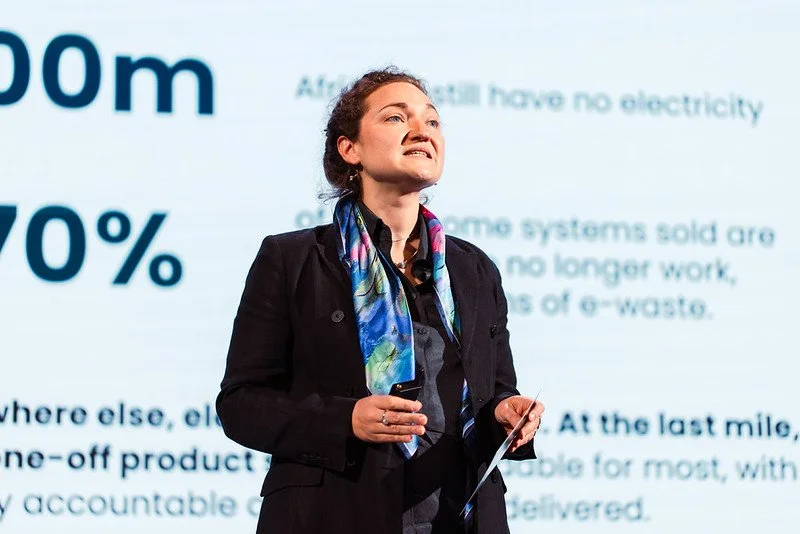
This is particularly relevant in the energy access sector, where momentum around initiatives such as Mission 300 has created renewed attention and urgency. Momentum is essential. However, momentum alone is not enough.
As Ieva noted, the sector must ensure that the drive to scale does not repeat past mistakes. Limited public funding must be directed where it can generate the greatest and most durable impact.
Rethinking what success looks like
A recurring theme across both events was the need to move beyond traditional measures of success.
Historically, energy access programmes have focused heavily on counting connections. While connections remain important, they are only the beginning of the story.
REAL Programme Catalyst's work increasingly points to a different question: what level of energy service do people actually receive over time?
This shift from measuring access to measuring service quality sits at the heart of the EaaS model.
Findings from the recent 60_decibels ‘Why Off-Grid Energy Matters’ report underscore the importance of on-going service and aftersales support, citing that energy access only creates meaningful impact when households, enterprises, and communities can reliably use energy to improve livelihoods, health, education, and resilience over the long term. A connection that cannot be maintained, financed, or effectively utilised ultimately falls short of its promise.
At the Nordic Climate Dialogues, Ieva was encouraged to hear growing recognition of this challenge. Discussions highlighted the importance of understanding impact, measuring results, learning from past failures, and ensuring that evidence informs future decisions.
Particularly notable were examples of development institutions redesigning how they use insights and evaluation findings so that lessons learned directly influence investment and policy decisions.
For REAL Programme Catalyst, this represents a critical shift. Evidence generation should not be an end in itself, but a tool for improving decision-making and directing resources toward approaches that deliver sustained outcomes.
The role of catalytic finance
Taken together, the conversations in New York and Helsinki reinforce a clear message: the future of energy access at the last mile depends on deploying capital differently.
More capital be required, and topublic funding must account for a greater share of the finance required to effectively close the energy access gap and connect the hardest to reach long-term.
However, with public funding stretched and capital is scarce, efficient use of funds is critical. In other words, governments must spend their subsidies wisely. One way to ensure this is by basing funding decisions on real-world evidence and data which determines which approaches work, and making catalytic finance available to accelerate them.
Catalytic finance has an essential role to play in helping innovative companies reach underserved communities, testing new approaches, and enabling business models that traditional financing often struggles to support. But catalytic capital is most effective when it is informed by evidence, designed around customer outcomes, and structured to strengthen markets rather than replace them.
This is where REAL Programme Catalyst sees significant opportunity.
By advancing Energy-as-a-Service approaches, supporting innovative financial mechanisms, and generating evidence on what drives long-term impact, the programme is helping shift the sector's focus from connections alone toward sustained energy services that improve lives.
Investing in EaaS at the last mile can cultivate local markets by nurting more financially robust off-grid energy companies. The benefits of doing so include local job creation, strong trust in local servicing for customer and critically through a financing lens, companies that can attract catalytic capital, able to keep their SHS assets on their balance sheets while raising equity.
This in turn creates opportunities for investor for deployment capitcal, catalysing faster deployment of SHS, effectively fast tracking electrification of entire targeted communities.
There is no doubt that the challenge ahead is significant. Funding is tightening, expectations are rising, and the hardest-to-reach communities remain underserved.
But the lessons emerging from across the sector are increasingly clear: achieving universal energy access will require smarter deployment of capital, stronger collaboration across ecosystems, and a relentless focus on the quality of service delivered to end users.
We must become truly catalytic using lessons from the past to drive deeper impact in the future.
